“Great is the rivalry, even greater the friendship”

Review of “Today we Die a Little – The Rise and Fall of Emil Zatopek, Olympic Legend” by Richard Askwith

zatopek

This excellent biography uses one of the famous quotes attributed to its subject as its title. But I’ve entitled this blog with a quote that struck me even more. It doesn’t feel very likely that an Olympic champion would say this about their fellow competitors these days. But the theme running through this book is that the Czech Emil Zatopek deserves the status of sporting hero as much for his generous spirit as his incredible achievements in athletics.

Before reading the book I had heard the name Zatopek as a famous athlete of the black and white era, but other than that knew nothing about him – exactly when he ran, what distances, what he won etc. But while I was approaching the subject fresh, I had read one of the author’s previous books about running – the mini-classic “Feet in the Clouds” – so I had high expectations. They were not disappointed.

Askwith has a breezy, eminently readable style that draws you in effortlessly to his subject. And Zatopek’s story is worth telling. A moderately talented athlete, he became the best primarily through sheer hard work – a maniacal training regime totally unusual for the time. This initially brought him a gold and silver in the 10,000m and 5,000m at the 1948 Olympics, as well as a number of records. But I knew so little about him I was even unaware of the achievement for which he is most famous – an unbelievable triple gold at the 1952 Helsinki Olympics of 5,000m, 10,000m and marathon. And I thought Mo Farah’s “double double” of 5,000m/10,000m golds at 2012 and 2016 was the greatest Olympic achievement in long distance running!

But there’s a lot more to this book than athletics. Equal weight is placed on exploring Zatopek’s personality – his cheerful demeanour, his time for fans and people generally, including the touching relationship with his wife. But in particular, the graciousness of his dealings with fellow athletes. Competing for Zatopek ultimately appears to have been a vehicle for making friends. He even gifted one of his Olympic medals to another athlete who had missed out through bad luck.

The book’s title mentions the “Rise and Fall” and, not unusually in sporting biography, we find that our hero’s life after retiring from their sport was not so spectacularly successful as their earlier career. Zatopek spoke out against the repression that followed the liberating “Prague Spring” of 1968 and was gradually frozen out of society as a result. He was dismissed from the Czech army and ended up working in a drilling gang in remote areas, living in a caravan.

It’s a real additional strength of the book that it acts as an effective history of Czechoslovakia, as well as of Zatopek. Ironically, Zatopek’s life (1922-2000) almost exactly dovetails that of the country. Much of that time it was a totalitarian state, and we are drawn into the difficulties and dilemmas of being that state’s most famous international figure (at times the book reads like some real life parallel of 1984 or a spy-thriller!). I was reminded of the best book I have read about the recent history of Northern Ireland – Johnny Rogan’s biography of Van Morrison. A good biography can do that.

Recommended. Put it on your Christmas list. It made me want to go out running.
 

The appeal of grassroots sport

There’s an emerging theme elsewhere on this site about my growing disenchantment with elite sport. While this stems from an ongoing planning battle in Leeds where Green Belt may be sacrificed for the purposes of redeveloping Headingley Stadium, it’s actually a general trend I’ve noticed. Footballers can certainly conjure up great matches, but we’re all aware of the ridiculous salaries. What substances are OK for the endurance athletes – runners, cyclists etc – to take or not to take? And while I understand that the golf at last week’s Ryder Cup was of an exceptional standard, I didn’t see it – the ugly, vulgar crowds put me right off from the start.

This is all particularly the case in Leeds where the City Council appears to have been dazzled by hosting the 2014 Tour de France Grand Depart and now can’t get enough of elite sport. Tour de Yorkshire, Olympic Parade, ITU Triathlon etc. Without fully appreciating that it may come at a cost. For the Triathlon earlier in the summer, we were boxed in our cul-de-sac for half a day so that 30 or so elite men and women could cycle down the main road once – 4 hours of road closure for 4 minutes of action. And now we might not be able to jog around our bit of the Meanwood Valley because they want it to redevelop Headingley – it’s just the latest in a long line…..

Meanwhile, I’ve been very happy to be dipping my toe back into a grassroots sport that I was taking pretty seriously 10 years or so ago – fellrunning. The appeal of this admittedly slightly eccentric sport has already been brilliantly described at length in Richard Askwith’s book “Feet in the Clouds”, which I fully recommend to all. A general theme to take from the book is that there is potentially as much appeal and interest in a local, down-to-earth scene like fellrunning as there is in the self-important and commercialised world of elite sport, which we all pay vast sums to Sky, BT etc to watch.

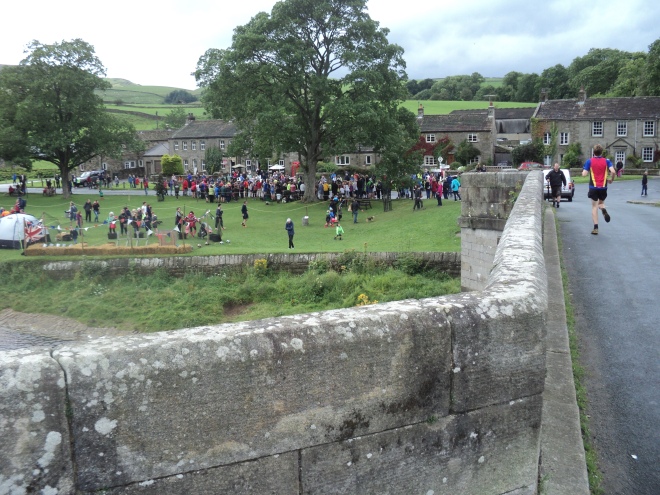
I was reminded of this the other week, lining up for my first fellrace for several years at Burnsall, in the Yorkshire Dales. Just a quick look round the field of 100 or so, I recognised a few faces, not because I knew them personally but because they are the “stars” of the sport. By stars I mean just very competent at what they do, well known on the circuit, with great results and records behind them. But their reasons for being there are just the same as mine – not for any money or glory, it’s just great fun to do. With the greatest respect to Mo Farah (whom I admire), I’m not likely to ever actually rub shoulders with him on a startline anywhere.

dsc02868

Burnsall was a great race to start again with. An idyllic scene, a race history that goes back to the 19th Century, and a great fellrunning challenge. Basically, you start on the village green, run through a gate and then go up through steep fields to the open fell. At this point the route narrows to a thin track up through the heather to the cairn, 800 feet above the village. When you go for a walk up a hill, one of the things that gets you to the top is the thought of a well-earned rest, a snack and a drink, taking in the view etc. Not with fellrunning. All that effort and within a split second you’re hurtling back down where you’ve come. This is particularly true of Burnsall, where the first half of the descent is so steep you have to put the brakes on to stay on your feet. You then jump a dry-stone wall (which is 6ft high as you approach it, but 9ft down on the other side!) and into the fields. The gradient here is slightly less steep and you can really fly down it, which accounts for the buzz of endorphins that sustain you over the finish line and for long after. Absolutely bloody exhausting, but so worth it.

Elite sport likes its stats but you can get into the stats of fellrunning too. The men’s record at Burnsall is 12.48, set over 30 years ago. Why hasn’t it been broken in all that time? In fact, if you look at the recent winners’ times they’ve actually been getting slower. Could it be that there is a competing event that attracts the top athletes? Is the heather longer now than it used to be? (it can really slow you down, particularly on the descent). Tantalisingly, the race programme reveals that the record ascent time is 8.22, and the record descent is 3.40, meaning that theoretically a 12 minute time is possible!

For me though, I took twice as long. Who cares though? It was just good to be back.

dsc02875


parkrun – “open and transparent”?

Recently, I’ve been getting back into running after a gap of several years. I’ve been doing a few local jogs around Meanwood, along with a few parkruns on Woodhouse Moor.

parkrun is something new to me, as it didn’t exist when I stopped running back in 2007. I’ve really enjoyed the 4 I’ve done. Apart from the fun of running 5km in a large group (around 400), perhaps the best thing is how little hassle it is. Before parkrun, entering a timed event involved the bother of registering, safety pins and paying a few quid. With parkrun, you just have to register online once, print out a barcode, remember to take it with you and be on the startline at 9am. And of course it’s free. This is currently available at 5 locations across Leeds every Saturday morning, plus a junior version in Roundhay Park every Sunday (which my kids do from time to time).

For me then, parkrun has been an entirely positive experience up to now. So obviously I was interested in the well-publicised story last week about a parish council in Gloucestershire proposing to charge its local parkrun. parkrun itself has been strongly in opposition to this. Its view is that parkrun encourages people to take healthy exercise and that introducing a charge would discourage many from participating. Clearly, parkrun doesn’t want this one case to set a precedent elsewhere in the country.

The parish council is arguing that parkrun has an impact on the park over and above general use. Therefore it should be charged a bit extra. I can actually see this argument. On the Woodhouse Moor route, some of the verges are quite cut up – it’s impossible for 400 runners to keep to the relatively narrow paths (particularly in the first 500 metres). And parkruns are run over exactly the same route, every week of the year, so there’s little chance for the verges to recover.

The key point here is about “public benefit” – is it better for society as a whole if the cherished principle of a free, weekly run is retained, even if it results in extra costs? This is a conundrum that crops up pretty often for me in my day job. I work for a charity that helps other local charitable groups. It’s often down to me to work out if the organisations that we help are indeed charitable; in other words, whether they work exclusively for the public benefit.

So, in trying to form a view about parkrun’s case, I did my usual research. Who exactly are parkrun? If you visit their website, at the bottom they tell you they are company no. 07289574 – Parkrun Ltd. But if you search for parkrun on the Companies House website you find that there are in fact 2 other parkrun companies – Parkrun Global Ltd and Parkrun Trading Ltd. Parkrun Global is a new company (registered in 2015) and appears similar to Parkrun Ltd (registered in 2010) but with an additional public benefit objective (about promoting and advancing health). Parkrun Trading is a wholly owned subsidiary of Parkrun Global and is a company limited by shares, which means that it does not work for public benefit.

So why the 3 companies? Perhaps because parkrun’s income comes from sponsors, both corporate and individuals, but it isn’t really made clear. And why is only Parkrun Ltd mentioned on the parkrun website? (particularly given that Parkrun Global appears more charitable).

Perhaps surprisingly, neither Parkrun Ltd nor Parkrun Global have registered as a charity with the Charity Commission. This is the most surefire way of reassuring the general public that your organisation exists entirely to “do good”. The last 4 years’ full accounts of registered charities are published on the Charity Commission website. At present, parkrun publishes a very long list of “donations and withdrawals” and uses this to describe itself as “open and transparent”.

But I feel the slightly curious picture around parkrun’s legal/charitable status, and how it chooses to communicate it, suggests that it could be even more open and transparent. Organisations that take a principled stand certainly should be as open and transparent as possible. Otherwise they risk being accused of not being solely motivated by altruism.

It would be great if parkrun could present a better explanation of its legal status. If it could clearly state that it was an organisation that existed exclusively for the public benefit, I’d be more comfortable with its case.

DSC02539

Towton Battlefield Trail

Back in October I went to see a production of Shakespeare’s Richard III at West Yorkshire Playhouse. Previous experience has told me that a bit of basic historical knowledge can really help your appreciation of The Bard’s genius, so over the autumn I found myself reading up on Richard’s reign and the whole War of the Roses period (1455-1485). It didn’t take too long to realise that many of the key events of the time took place around West Yorkshire, and that many of the key sites can still be visited today.

And perhaps the most significant event of all was the Battle of Towton, which took place on 29 March 1461 (or 555 years ago today if you prefer). Historical opinion seems to vary on the exact scale of the battle, but clearly tens of thousands of men were involved, of which a very high proportion died, and the Yorkist’s victory over the Lancastrians dictated national events for the next 24 years. Visiting the battlefield today, the Towton Battlefield Society has created an excellent 2-mile Battlefield Trail which manages to combine a full interpretation of events into (perhaps ironically) a pleasant country ramble, which is described below.

Allow up to 2 hours to complete the full circuit. Most of it is around fields but a map is not really needed as the Trail is clearly marked and easy to follow. The route is flattish with a few undulations, and although I went when it was bone dry some parts could get muddy, so choose footwear accordingly.

Start at the lay-by next to the memorial cross on the B1217, half a mile south of Towton village, which itself lies 3 miles south of Tadcaster. The trail is divided into 2 sections, each section covering the 2 main phases of the battle. What becomes immediately obvious is how the geography of the landscape around you helps your understanding of the turn of events. The first section is a simple “there and back” of half a mile which takes you to the first of 10 interpretation panels that line the route. At the cross, you are on the line of the Lancastrians’ position at the start of the battle early in the morning. Ahead of you is a minor vale, with the horizon 200 yards away being the Yorkists’ initial line. So, much of the day’s action (and it was a full day, which partly accounts for casualty figures) took place right where you’re walking, a sobering thought.

DSC02375Returning to the cross, the remainder of the route covers the ground of the Lancastrians’ retreat and ultimate defeat. Late in the day of the battle, Yorkist reinforcements arrived which turned the tide in their favour. This put the Lancastrians to flight, but while the initial phases were fought on relatively flat ground, the line of escape was down into the valley of the Cock Beck. Many of the retreating soldiers met their grisly end trying to cross the Beck (which was swollen by falling snow). From Panels 4 and 5 you view the so-called “Bloody Meadow”, which tells its own story. The Trail follows the edge of the escarpment, so it is easy to imagine the difficulties the retreating soldiers faced.

After a mile of easy walking along a green track, passing more interpretation panels, the route enters Towton village where refreshment is available (when open) at The Rockingham Arms – you might need a pint by then. The remainder of the route follows the road back to the starting point, although happily most of this is on a path to the side of the road, which makes the route possible not just for grown-ups but for families with kids as well.

In closing, when I got back to the car on this particular chilly March day in 2016 I reflected that all I really had to worry about was how long it would take for the heater to kick in and for my feet to warm up. The soldiers on that snowy morning in March 1461 faced a somewhat starker reality. Perhaps we can’t be reminded too often how lucky we are to live in such relatively peaceful times.

Recognise this Meanwood building?

WP_20141219_001

Source: West Yorkshire Archive Service

Here are some clues. The photo was taken in 1920 and the bowling green in the foreground, with its shed, bench and decorative flower pot, is now occupied by flats. And because of this, it’s not possible to take a photo from the same location today. Here’s the nearest possible equivalent:

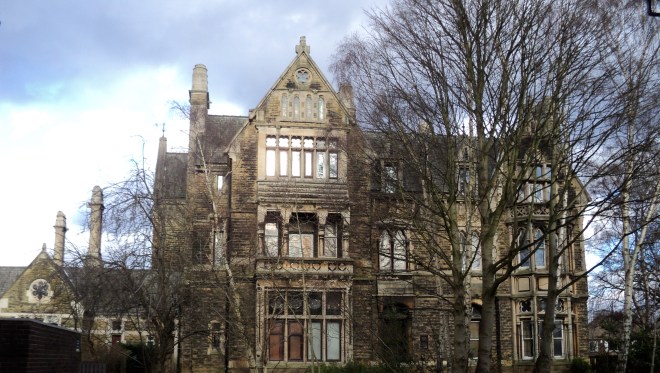
DSC02313Of course, this is Meanwood Towers, one of the most eccentric-looking buildings in the area. I came across the 1920 photo last year during a visit to West Yorkshire Archive Service (who have kindly confirmed that the photo can be published) and the comparison between then and now is fascinating. The building itself has altered slightly with some of the taller chimneys and the top tower removed for safety reasons many years ago. But what is most striking is how the Towers stood alone from any other buildings in 1920 – indeed the photo is taken from a “sales particulars” document designed to attract potential buyers of the Towers and surrounding estate. Now, the Towers are hemmed in by housing and the view above is obscured in summer when the trees are in leaf.

I find this a pretty good example of why local history can be so interesting – things we take for granted today were not always the same way. It’s worthwhile from time to time browsing the terrific Leodis photographic archive of Leeds and seeing how places across the city have changed over the years. Search using the keyword Meanwood Towers to see the existing old photos of the Towers on the site – I will ask for the 1920 photo to be added.

There is one outstanding mystery about Meanwood Towers if anyone can help. When originally built by Thomas Kennedy in the 19th century, alongside the main building was a separate 800-seat concert hall, 40 yards from the front door. Kennedy had built this to house a church organ for his wife, specially-commissioned from the Schulze organ builders in Germany; sadly, shortly after the organ was installed she fell ill and was unable to play the instrument. The organ was put up for sale and eventually ended up at St Bartholomew’s Church, Armley, where it remains to this day. Now I’m not really a great appreciator of church organ music (I’m more of a Springsteen man myself) but the literature suggests that the quality of the workmanship and its setting in St Bart’s makes the Armley Schulze Organ one of the best-regarded of all such instruments.

Which is all quite remarkable given that it began life 150 years ago in a dedicated 800-seat venue on a site now occupied by suburban housing on Towers Way in Meanwood. The organ house was built of wood and with the organ gone it slowly became dilapidated, and maps of the area indicate that it was finally removed in the 1940s. I’ve never found a photograph of the organ house (unfortunately there wasn’t one in the 1920 sales particulars) so does anyone have one they are willing to share?