From Meanwood to the Dales

I was asked the other day why I thought the Meanwood Valley was so special. As I’ve spent much of 2016 trying to help protect one particularly valuable corner of the Valley, I thought this was a pretty timely question.

I ended up thinking about my first impressions of Meanwood Valley, which I got to know pretty well shortly after I moved to the area in 2005 (I’d never lived in Leeds before then). These days when people move to a new area, I guess they do some web searches and find out as much as they can about it online. But back then, and as a Rambler at heart, my first thoughts turned to the good old Ordnance Survey map.
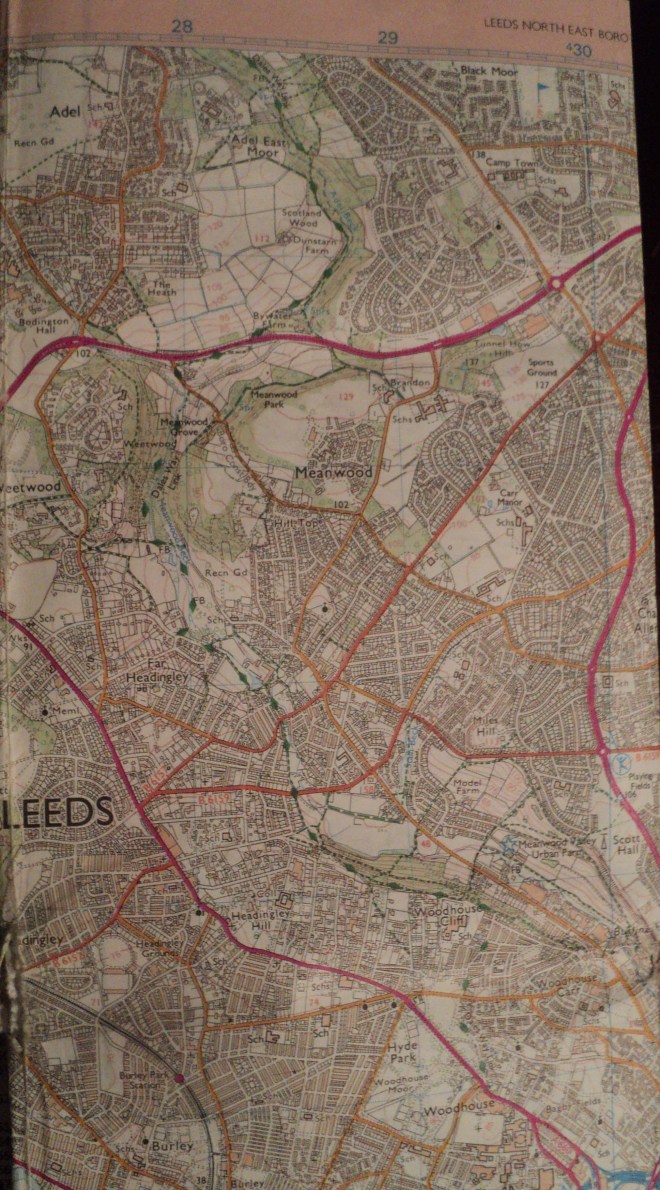
Version 2

And glancing at the map, the appeal of the Meanwood Valley to me was immediately obvious. Here was a green corridor extending almost from Leeds city centre, continuing for several miles north through the suburbs and out into the open countryside. Not only that, a clear public footpath ran all the way up the valley and beyond. Looking more closely revealed the words “Dales Way link” – thus Meanwood was a route by which you could walk from Leeds to the Yorkshire Dales and beyond.

Nowhere else in Leeds is this characteristic so marked. I suppose I was spoilt by having lived in Sheffield for many years where a number of green, accessible-on-foot valleys link the inner city with the Peak District to the west. So from the outset, I rather cherished the idea of one day walking out of my new house in Meanwood and (apart from the first 10 minutes of suburbia) all the way through countryside up the Valley and into the Dales.

But for one reason or another, for the next 8 years it never happened. And if it was easy to point to having young children to bring up as why, then this became the reason why it eventually did happen. Young child 1 had grown to become a restless 9 year-old with another long summer day to kill. “Why don’t we go for a walk or something Dad?” “OK, would you walk to Bramhope?” “Where’s Bramhope?” “Don’t worry, just follow me”.

We walked the 5 miles to Bramhope up the Valley, past Eccup Reservoir and into the village by some ridiculously-sized mansions. Then we got the bus back. 9 year-old had got the bug. Over the rest of that summer and autumn, we did a sequence of walks, each time driving to where the previous leg had finished, walking a few more miles, then getting the bus or train back. Bramhope to Menston, Menston to Ilkley, Ilkley to Bolton Abbey, Bolton Abbey to Grassington and, finally, Grassington to Buckden. We’d gone from Meanwood to the top of Wharfedale in 6 steps – 40 miles or so in total. For 9 year-old (now 12) it was quite an achievement.

Buckden is the bus terminus, so our journey was forced to stop there. But still there was something magical about the adventure, about having had the chance to escape from the city and into the National Park on foot. I’d like to think that future newcomers to Leeds would have the same chance.


dsc01716

Otley Chevin from Burley Moor

dsc01728

Approaching Bolton Abbey

dsc01763

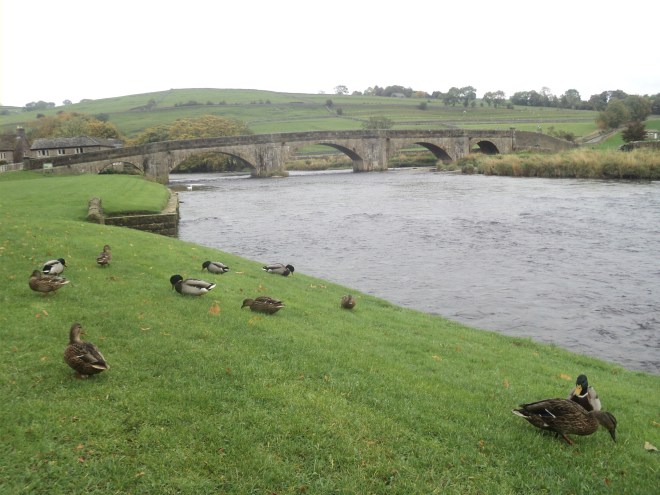
Burnsall bridge


dsc01765

Crossing the Wharfe near Hebden


“Great is the rivalry, even greater the friendship”

Review of “Today we Die a Little – The Rise and Fall of Emil Zatopek, Olympic Legend” by Richard Askwith

zatopek

This excellent biography uses one of the famous quotes attributed to its subject as its title. But I’ve entitled this blog with a quote that struck me even more. It doesn’t feel very likely that an Olympic champion would say this about their fellow competitors these days. But the theme running through this book is that the Czech Emil Zatopek deserves the status of sporting hero as much for his generous spirit as his incredible achievements in athletics.

Before reading the book I had heard the name Zatopek as a famous athlete of the black and white era, but other than that knew nothing about him – exactly when he ran, what distances, what he won etc. But while I was approaching the subject fresh, I had read one of the author’s previous books about running – the mini-classic “Feet in the Clouds” – so I had high expectations. They were not disappointed.

Askwith has a breezy, eminently readable style that draws you in effortlessly to his subject. And Zatopek’s story is worth telling. A moderately talented athlete, he became the best primarily through sheer hard work – a maniacal training regime totally unusual for the time. This initially brought him a gold and silver in the 10,000m and 5,000m at the 1948 Olympics, as well as a number of records. But I knew so little about him I was even unaware of the achievement for which he is most famous – an unbelievable triple gold at the 1952 Helsinki Olympics of 5,000m, 10,000m and marathon. And I thought Mo Farah’s “double double” of 5,000m/10,000m golds at 2012 and 2016 was the greatest Olympic achievement in long distance running!

But there’s a lot more to this book than athletics. Equal weight is placed on exploring Zatopek’s personality – his cheerful demeanour, his time for fans and people generally, including the touching relationship with his wife. But in particular, the graciousness of his dealings with fellow athletes. Competing for Zatopek ultimately appears to have been a vehicle for making friends. He even gifted one of his Olympic medals to another athlete who had missed out through bad luck.

The book’s title mentions the “Rise and Fall” and, not unusually in sporting biography, we find that our hero’s life after retiring from their sport was not so spectacularly successful as their earlier career. Zatopek spoke out against the repression that followed the liberating “Prague Spring” of 1968 and was gradually frozen out of society as a result. He was dismissed from the Czech army and ended up working in a drilling gang in remote areas, living in a caravan.

It’s a real additional strength of the book that it acts as an effective history of Czechoslovakia, as well as of Zatopek. Ironically, Zatopek’s life (1922-2000) almost exactly dovetails that of the country. Much of that time it was a totalitarian state, and we are drawn into the difficulties and dilemmas of being that state’s most famous international figure (at times the book reads like some real life parallel of 1984 or a spy-thriller!). I was reminded of the best book I have read about the recent history of Northern Ireland – Johnny Rogan’s biography of Van Morrison. A good biography can do that.

Recommended. Put it on your Christmas list. It made me want to go out running.


The appeal of grassroots sport

There’s an emerging theme elsewhere on this site about my growing disenchantment with elite sport. While this stems from an ongoing planning battle in Leeds where Green Belt may be sacrificed for the purposes of redeveloping Headingley Stadium, it’s actually a general trend I’ve noticed. Footballers can certainly conjure up great matches, but we’re all aware of the ridiculous salaries. What substances are OK for the endurance athletes – runners, cyclists etc – to take or not to take? And while I understand that the golf at last week’s Ryder Cup was of an exceptional standard, I didn’t see it – the ugly, vulgar crowds put me right off from the start.

This is all particularly the case in Leeds where the City Council appears to have been dazzled by hosting the 2014 Tour de France Grand Depart and now can’t get enough of elite sport. Tour de Yorkshire, Olympic Parade, ITU Triathlon etc. Without fully appreciating that it may come at a cost. For the Triathlon earlier in the summer, we were boxed in our cul-de-sac for half a day so that 30 or so elite men and women could cycle down the main road once – 4 hours of road closure for 4 minutes of action. And now we might not be able to jog around our bit of the Meanwood Valley because they want it to redevelop Headingley – it’s just the latest in a long line…..

Meanwhile, I’ve been very happy to be dipping my toe back into a grassroots sport that I was taking pretty seriously 10 years or so ago – fellrunning. The appeal of this admittedly slightly eccentric sport has already been brilliantly described at length in Richard Askwith’s book “Feet in the Clouds”, which I fully recommend to all. A general theme to take from the book is that there is potentially as much appeal and interest in a local, down-to-earth scene like fellrunning as there is in the self-important and commercialised world of elite sport, which we all pay vast sums to Sky, BT etc to watch.

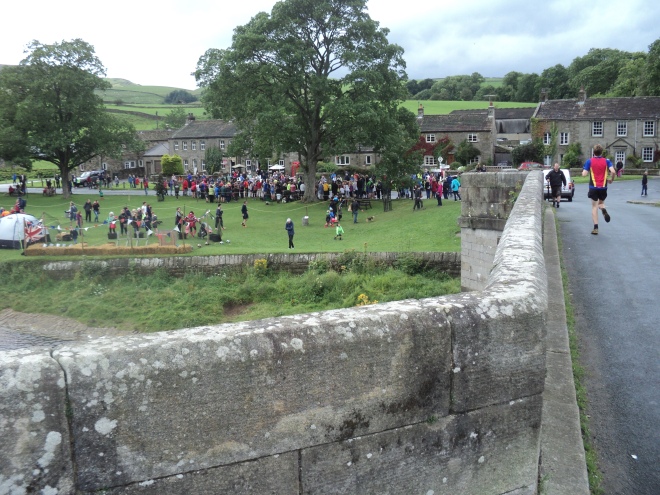
I was reminded of this the other week, lining up for my first fellrace for several years at Burnsall, in the Yorkshire Dales. Just a quick look round the field of 100 or so, I recognised a few faces, not because I knew them personally but because they are the “stars” of the sport. By stars I mean just very competent at what they do, well known on the circuit, with great results and records behind them. But their reasons for being there are just the same as mine – not for any money or glory, it’s just great fun to do. With the greatest respect to Mo Farah (whom I admire), I’m not likely to ever actually rub shoulders with him on a startline anywhere.

dsc02868

Burnsall was a great race to start again with. An idyllic scene, a race history that goes back to the 19th Century, and a great fellrunning challenge. Basically, you start on the village green, run through a gate and then go up through steep fields to the open fell. At this point the route narrows to a thin track up through the heather to the cairn, 800 feet above the village. When you go for a walk up a hill, one of the things that gets you to the top is the thought of a well-earned rest, a snack and a drink, taking in the view etc. Not with fellrunning. All that effort and within a split second you’re hurtling back down where you’ve come. This is particularly true of Burnsall, where the first half of the descent is so steep you have to put the brakes on to stay on your feet. You then jump a dry-stone wall (which is 6ft high as you approach it, but 9ft down on the other side!) and into the fields. The gradient here is slightly less steep and you can really fly down it, which accounts for the buzz of endorphins that sustain you over the finish line and for long after. Absolutely bloody exhausting, but so worth it.

Elite sport likes its stats but you can get into the stats of fellrunning too. The men’s record at Burnsall is 12.48, set over 30 years ago. Why hasn’t it been broken in all that time? In fact, if you look at the recent winners’ times they’ve actually been getting slower. Could it be that there is a competing event that attracts the top athletes? Is the heather longer now than it used to be? (it can really slow you down, particularly on the descent). Tantalisingly, the race programme reveals that the record ascent time is 8.22, and the record descent is 3.40, meaning that theoretically a 12 minute time is possible!

For me though, I took twice as long. Who cares though? It was just good to be back.

dsc02875