Poetry in Motion

Linking the Stanza Stones in one continuous journey

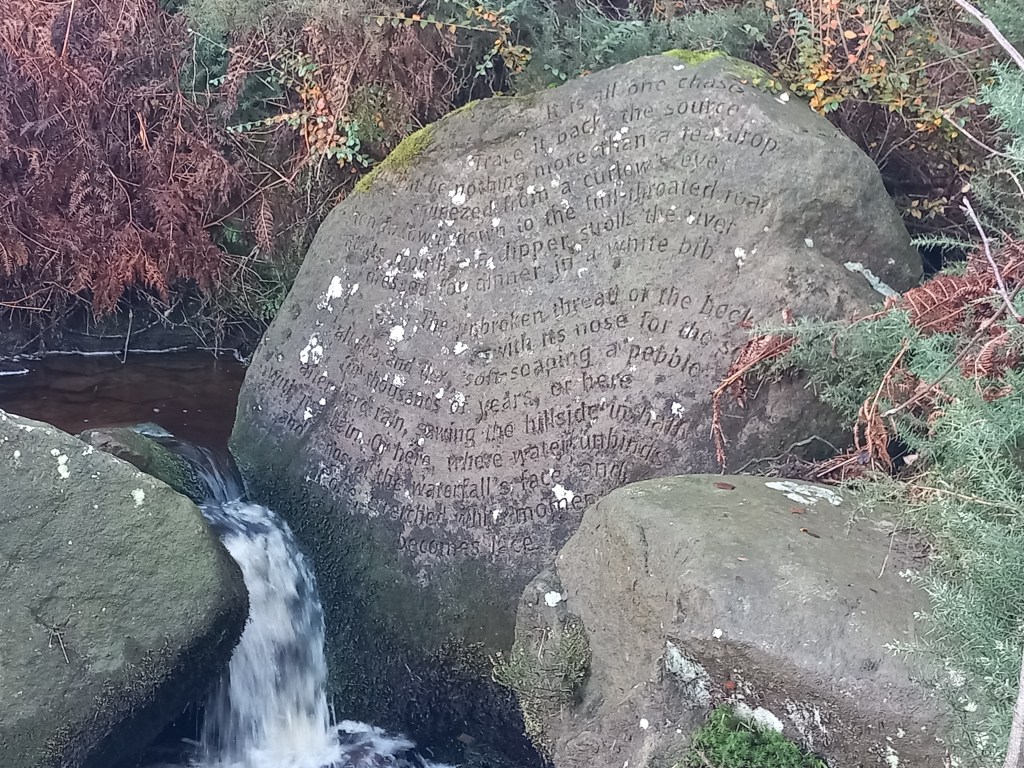
Over the last few weeks I’ve been filling in the pieces of an outdoor jigsaw puzzle. Namely, visiting all of the so-called “Stanza Stones”, six poems by Poet Laureate Simon Armitage carved into rock on the South Pennine Moors. The stones are located between Marsden (where Simon grew up) and Ilkley (Ilkley Literature Festival originally sponsored the project). Each poem is based on water in its various physical states – Snow, Rain, Mist, Dew, Puddle and Beck – and there’s plenty of all up here at this time of year. The rocks themselves are variously quarry walls, existing crags and boulders, as well as stones transported to site. Some are very prominent, others more difficult to locate. It’s been like a mini-treasure hunt tracking them all down, but eventually I found all six:
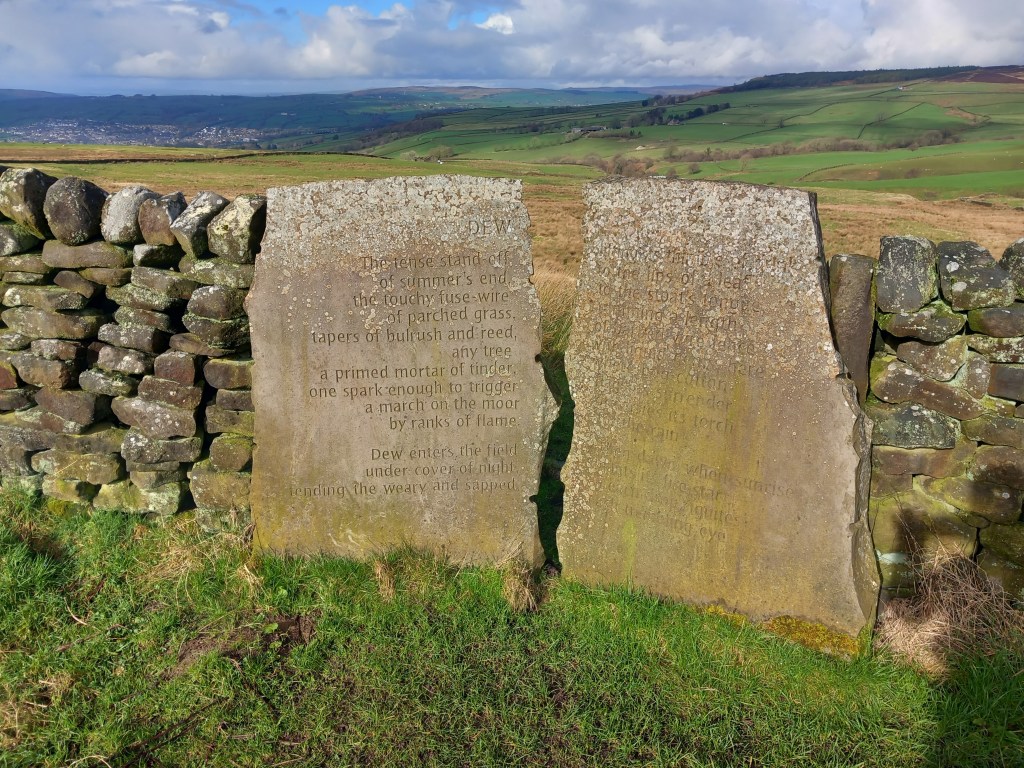
Dew
Mist
Rain
Beck
Puddle
Snow

There’s much to take in here – the poems themselves, their placing, the use of materials, the style of carving, how they all relate to the landscape/local area etc – all of which are potentially quite thought-provoking. However I will focus now on one specific aspect, namely the various ways in which you could link all six in one continuous journey.

As the crow flies (according to freemaptools.com) it’s 23 miles from Marsden to Ilkley, both of which are served by train stations, so immediately the idea of a route between them via the Stanza Stones seems possible. In fact, there are already three published routes that do just that:

Firstly, there is the original “official” route published by Ilkley Literature Festival, 47 miles in total (so obviously it must wind about a bit). It follows the Pennine Way to Hebden Bridge, then cuts north east to Bingley before a circuitous route around Rombald’s Moor to Ilkley.
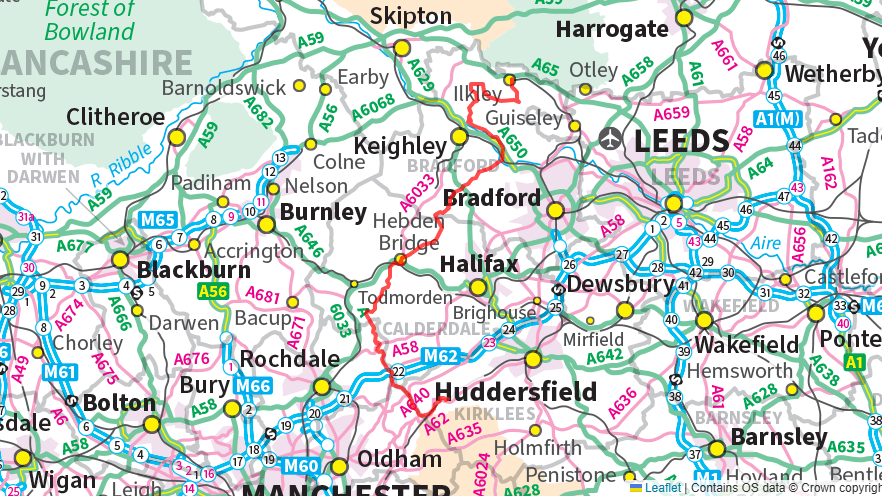
An alternative Stanza Stones Walk has also been published by Mick Melvin, building on the literary theme by visiting Mytholmroyd and Haworth as well, homes of Ted Hughes and the Brontes respectively. This route adds a few miles to the original so it’s nearer 50 miles in total.

Lastly, there is now a Stanza Stones 50 mile Ultra, first organised by CraggRunner in 2023 and set for its third running on Saturday 7 June 2025. This route combines elements of the previous two with 5 checkpoints. With a 9am start you have 24 hours to complete the 50 miles with 6800ft of ascent. Entry is available here for £58-£70, minimum age 20 years.

Of course you don’t have to follow published routes, and it would be fun to come up with individual variations. If the straight-line distance beginning to end is 23 miles there must be scope to shave a bit off 47-50 miles! I quite like devising running routes with a loose “theme” of sorts, so if I come up with a good alternative of my own I will share it here.

As an added bonus, between the Puddle and Beck Stones on Ilkley Moor you pass the Stanza Stones Poetry Seat at Gill Head, colloquially known as Poetry Corner. Here you can contribute poems of your own by posting them in the postbox-like “Poetry Box”, and with a crank of the handle reaveal others previously-contributed. You get a nice mix of stuff in here, mostly funny or a bit rude, it’s all good fun. Here’s a couple I’ve liked previously:

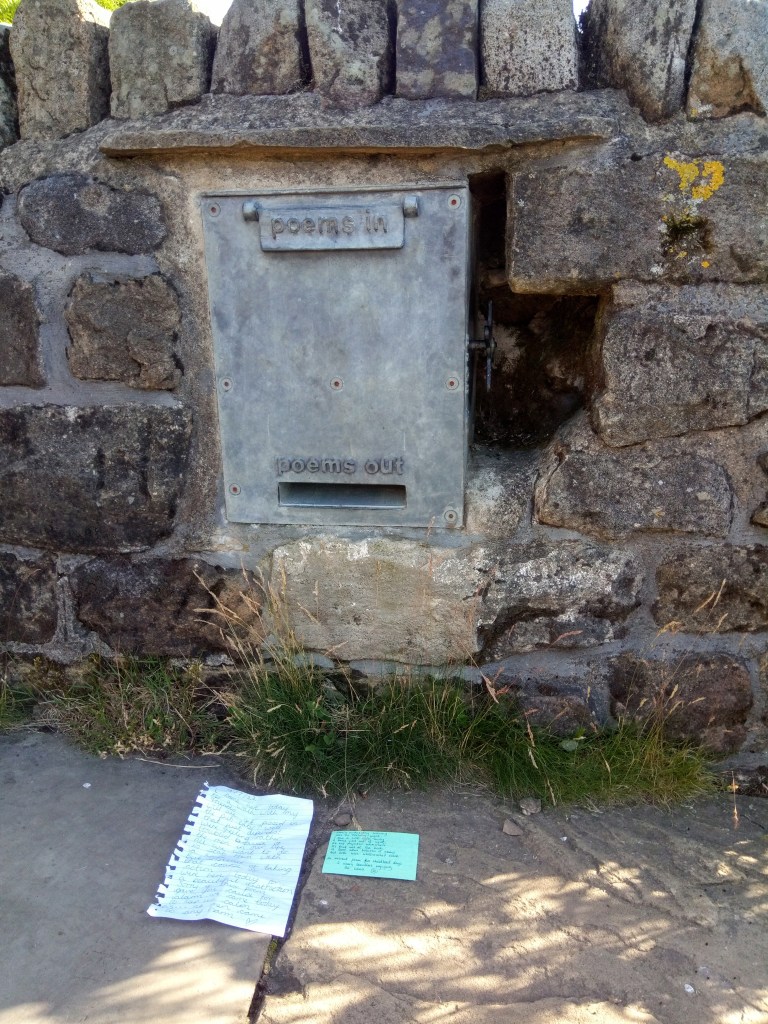
More information about the Stanza Stones project, including the poems themselves, can be found here. My favourite is “Rain”, quite possibly because it was hoofing it down when I visited, freshwater tears indeed…

Be glad of these freshwater tears,
Each pearled droplet some salty old sea-bullet
Air-lifted out of the waves, then laundered and sieved, recast as a soft bead and returned.
And no matter how much it strafes or sheets, it is no mean feat to catch one raindrop clean in the mouth,
To take one drop on the tongue, tasting cloud pollen, grain of the heavens, raw sky.
Let it teem, up here where the front of the mind distils the brunt of the world.


parkrun – “open and transparent”?

Recently, I’ve been getting back into running after a gap of several years. I’ve been doing a few local jogs around Meanwood, along with a few parkruns on Woodhouse Moor.

parkrun is something new to me, as it didn’t exist when I stopped running back in 2007. I’ve really enjoyed the 4 I’ve done. Apart from the fun of running 5km in a large group (around 400), perhaps the best thing is how little hassle it is. Before parkrun, entering a timed event involved the bother of registering, safety pins and paying a few quid. With parkrun, you just have to register online once, print out a barcode, remember to take it with you and be on the startline at 9am. And of course it’s free. This is currently available at 5 locations across Leeds every Saturday morning, plus a junior version in Roundhay Park every Sunday (which my kids do from time to time).

For me then, parkrun has been an entirely positive experience up to now. So obviously I was interested in the well-publicised story last week about a parish council in Gloucestershire proposing to charge its local parkrun. parkrun itself has been strongly in opposition to this. Its view is that parkrun encourages people to take healthy exercise and that introducing a charge would discourage many from participating. Clearly, parkrun doesn’t want this one case to set a precedent elsewhere in the country.

The parish council is arguing that parkrun has an impact on the park over and above general use. Therefore it should be charged a bit extra. I can actually see this argument. On the Woodhouse Moor route, some of the verges are quite cut up – it’s impossible for 400 runners to keep to the relatively narrow paths (particularly in the first 500 metres). And parkruns are run over exactly the same route, every week of the year, so there’s little chance for the verges to recover.

The key point here is about “public benefit” – is it better for society as a whole if the cherished principle of a free, weekly run is retained, even if it results in extra costs? This is a conundrum that crops up pretty often for me in my day job. I work for a charity that helps other local charitable groups. It’s often down to me to work out if the organisations that we help are indeed charitable; in other words, whether they work exclusively for the public benefit.

So, in trying to form a view about parkrun’s case, I did my usual research. Who exactly are parkrun? If you visit their website, at the bottom they tell you they are company no. 07289574 – Parkrun Ltd. But if you search for parkrun on the Companies House website you find that there are in fact 2 other parkrun companies – Parkrun Global Ltd and Parkrun Trading Ltd. Parkrun Global is a new company (registered in 2015) and appears similar to Parkrun Ltd (registered in 2010) but with an additional public benefit objective (about promoting and advancing health). Parkrun Trading is a wholly owned subsidiary of Parkrun Global and is a company limited by shares, which means that it does not work for public benefit.

So why the 3 companies? Perhaps because parkrun’s income comes from sponsors, both corporate and individuals, but it isn’t really made clear. And why is only Parkrun Ltd mentioned on the parkrun website? (particularly given that Parkrun Global appears more charitable).

Perhaps surprisingly, neither Parkrun Ltd nor Parkrun Global have registered as a charity with the Charity Commission. This is the most surefire way of reassuring the general public that your organisation exists entirely to “do good”. The last 4 years’ full accounts of registered charities are published on the Charity Commission website. At present, parkrun publishes a very long list of “donations and withdrawals” and uses this to describe itself as “open and transparent”.

But I feel the slightly curious picture around parkrun’s legal/charitable status, and how it chooses to communicate it, suggests that it could be even more open and transparent. Organisations that take a principled stand certainly should be as open and transparent as possible. Otherwise they risk being accused of not being solely motivated by altruism.

It would be great if parkrun could present a better explanation of its legal status. If it could clearly state that it was an organisation that existed exclusively for the public benefit, I’d be more comfortable with its case.

DSC02539